Ron Hill
Hold TightRon Hill, Betsy Hill’s husband and Spencer Hill’s father, responds to his son’s suicide by trying to contain its aftermath: he removes a chair, strips a locker, and initially keeps a consequential discovery to himself. Beneath that restraint, however, lies a grief shaped by fear, self-accusation, and the conviction that he failed to see how much Spencer was suffering. When Ron finally reveals what he found in Spencer’s room, the family’s private mourning intersects with the investigation surrounding Adam Baye.
Identity and Family
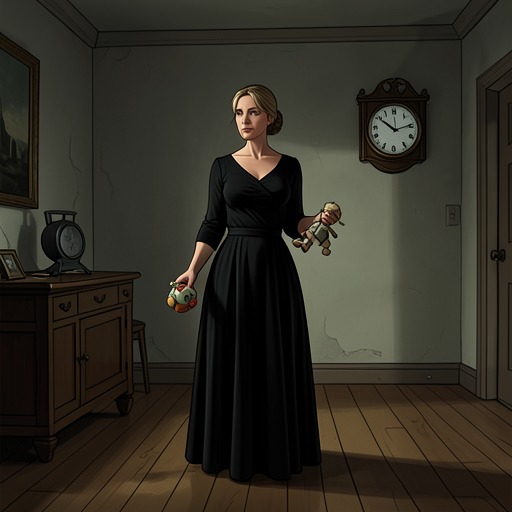
Ron is portrayed as a physically composed man whose appearance makes the damage of bereavement less visible. When Betsy watches him arrive in his Audi, she still sees a handsome man: his hair has turned almost entirely gray, but his blue eyes resemble Spencer’s, his face remains smooth, and he has kept fit and watched his diet. The resemblance is an ordinary family feature made newly painful by the absence of the son who shared it.
Ron and Betsy are raising their twins as well as grieving Spencer, their only son. Their different ways of handling the loss create a quiet division at home. The twins respond in contrasting ways: one withdraws by ignoring what happened, while the other sulks. Betsy tries to keep family routines going, but Ron is sometimes absent even when he has returned home; on some nights he parks in the garage and cries in the car. His grief is not simply an interior feeling: it alters the rhythms of the household and leaves Betsy fearing what his isolation might lead him to do.
Grief and the House After Spencer
In the days after Spencer’s death, Ron tries to make the house bearable by removing signs of his son. Two days after the suicide, he takes Spencer’s dinner chair to the basement. He also removes Spencer’s named locker and begins filling it with miscellaneous things. To Betsy, these actions suggest an effort to put Spencer out of sight. She does not follow the same course: when Ron starts packing away Spencer’s room the day after the death, she stops him firmly. Her distinction between bending and breaking becomes a boundary within their shared grief; for her, preserving the room is not a refusal to face the death but a refusal to erase her son’s place in the family.
Ron’s absence intensifies Betsy’s fear. She knows that he sometimes sits in the garage and cries, and imagines him leaving the engine running with the garage door closed, repeating the means by which Spencer died. The possibility makes grief feel like a danger that could reproduce itself. Ron’s silence about Spencer offers Betsy little reassurance, while his efforts to remove reminders seem to leave her carrying the visible mourning alone.
The objects in Spencer’s room later show the limits of that attempt at removal. Betsy keeps the room intact, and Ron eventually returns to it when no one else is home. He stands in the doorway and looks at the bed, as if sustained attention might make Spencer appear there again, lying on his back and staring at the ceiling. The room is at once something Ron has tried to pack away and a place he cannot stop revisiting in memory.
Guilt and What Ron Believes He Missed
Ron’s guilt attaches to both what he noticed and what he did not. In retrospect, he recalls Spencer as often morose and unusually sad, yet remembers treating the signs as something a child might outgrow. He also remembers opening Spencer’s closed bedroom door without knocking, seeing tears in his son’s eyes, asking whether everything was all right, and accepting the answer that it was. The memory turns a familiar exchange into evidence of how little those brief questions established.
He blames himself for failing to recognize a change in Spencer’s behavior, and for leaving pills and vodka where Spencer could reach them. Ron knows that Spencer mixed pills and alcohol, and that the vodka came from the family cabinet while the pills came from Ron’s medicine chest. He also knows that he had left his prescription bottle in view and kept seeking renewals for medication he felt he should have stopped needing. In his account, these facts do not make him responsible for every choice Spencer made, but they sharpen his sense that he made access easy and missed the depth of his son’s distress.
Ron’s self-reproach also reaches beyond the immediate circumstances of the death. He remembers hating his job, the noise and obligations of family life, and the recurring chores and expenses of maintaining a household. He had longed for solitude in a cabin in the woods, beyond the reach of a cell phone. He rejects the idea that calling this a midlife crisis would adequately explain it; to him, that would be too convenient an escape from the harder truth that he had wanted to get away. After Spencer dies, Ron interprets that wish with terrible irony, as though the escape he desired had been granted through the loss of his son.
The Photograph and the Search
When Betsy presents a photograph from Spencer’s MySpace memorial page, Ron takes it and studies it. His response is physical as well as verbal: he twitches, stiffens, puts the picture down, folds his arms, and picks it up again. The photograph changes the atmosphere between him and Betsy, and he urges that the person they are looking for be found. Yet when Betsy asks what the image changes, the scene leaves Ron’s reaction unresolved; his agitation is evident, but the photograph alone does not settle what happened on the night Spencer died.
The episode connects the Hills’ grief to the effort to understand Spencer’s final hours. Ron is not presented as having a complete explanation. His insistence on finding the person in question sits alongside his earlier belief that discovering the truth might not change Spencer’s death or offer Betsy a way to heal. The distinction matters: his search may help establish facts, but it cannot undo the loss that gives those facts their weight.
The Hidden Evidence and Its Consequences
On the night Spencer died, Ron searched his son’s room and found eight thousand dollars in cash beneath the bed, along with prescription materials. He did not tell Betsy. He reasoned that Spencer was already dead and that disclosure would put her through more pain without changing anything. The decision echoes his earlier habit of putting Spencer’s belongings out of sight, but this time what he conceals is not a keepsake: it is evidence that can affect how another young person is understood.
Much later, Ron tells Adam Baye and the others that he found the money and the prescription pad. He stops, swallows, and looks toward the ceiling before continuing, making the difficulty of the disclosure visible. Betsy recognizes the consequence at once: the discovery means Adam did not steal his father’s prescription pads. Ron’s delayed confession therefore changes the meaning of a suspicion that had fallen on Adam, even as it exposes how long Ron carried information that might have mattered to the family’s search for the truth.
Ron’s role in the story rests on that tension between protection and concealment. He tries to spare Betsy by withholding what he found, just as he tries to manage grief by removing Spencer’s chair and locker. But grief does not become manageable through absence: the returned gaze toward the empty bed, the photograph handled and picked up again, and the evidence finally placed on the table all bring back what his silences could not settle. His disclosure helps clear Adam, while leaving Ron’s central burden—his belief that he failed Spencer—unresolved.